

In today’s competitive and safety-driven job market particularly in construction, oil & gas, manufacturing, and technical services employers can no longer rely solely on resumes or interviews.
Trade tests play a critical role in verifying a worker’s practical skills, job knowledge, and safety awareness before hiring. By conducting trade tests prior to recruitment, companies ensure candidates are job-ready from day one, reducing risks and improving productivity.
For overseas and GCC projects, where compliance standards are strict and replacement costs are high, trade testing has become an essential step in the recruitment process, helping employers hire skilled, reliable, and safety-conscious workers with confidence.
What Is a Trade Test?
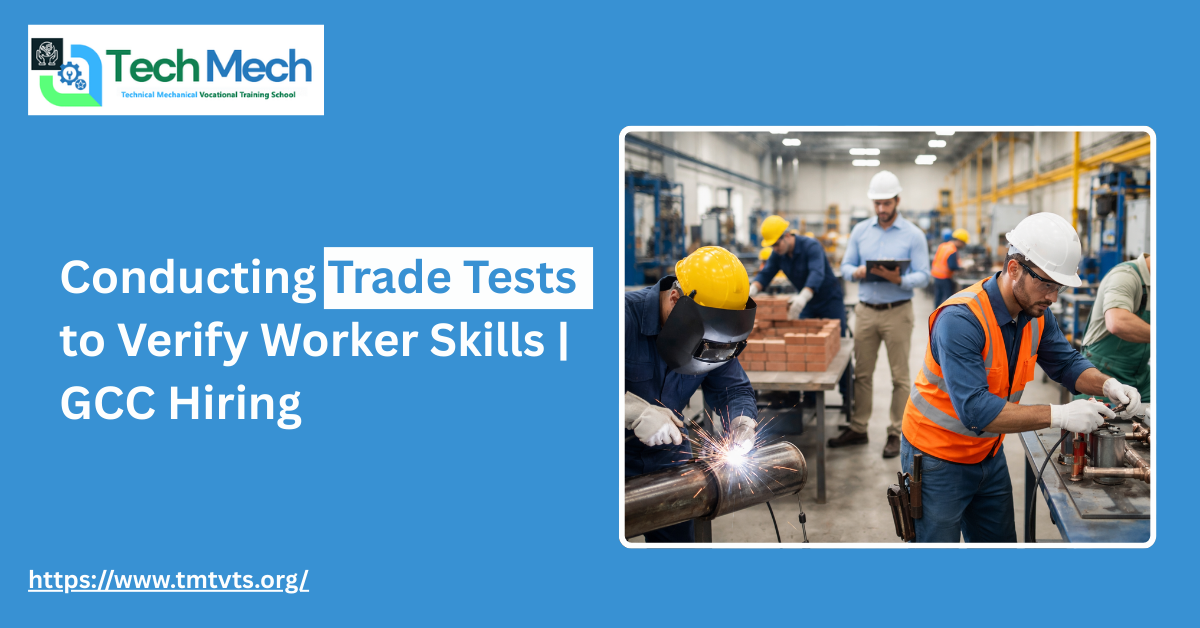
A trade test is a practical, hands-on assessment designed to evaluate a worker’s technical ability, job knowledge, practical experience, and safety awareness in a specific trade. Instead of asking theoretical questions, candidates are required to perform real tasks that closely match actual job-site work.
For example:
- A welder may be asked to perform a specific welding joint
- An electrician may be required to wire a circuit or troubleshoot a fault
- A plumber may install piping or fixtures
- A mason may construct a small brickwork section
The primary objective of a trade test is simple: to confirm whether a worker can safely and correctly perform the job they are being hired for.
Why Trade Tests Are Critical Before Hiring
Many employers have experienced the consequences of hiring untested workers—poor workmanship, safety incidents, missed deadlines, material wastage, and increased supervision costs. Trade tests significantly reduce these risks.
1. Ensuring Workplace Safety
Skilled workers understand tool handling, safety procedures, and risk prevention. Trade tests quickly reveal whether a worker follows safety rules or ignores them. In industries like construction and oil & gas, this can prevent serious accidents and liabilities.
2. Guaranteeing Quality Work
A trade-tested worker delivers durable, accurate, and standards-compliant work. This is especially important for international projects where clients expect strict quality control.
3. Reducing Costs and Rework
Hiring the wrong worker leads to wasted wages, damaged materials, and costly rework. A trade test is a small upfront investment that saves significant long-term expenses.
4. Improving Employer Confidence
Employers gain confidence knowing that workers have already proven their skills under real working conditions.
Industries and Jobs That Require Trade Tests
Trade tests are widely used across multiple industries, particularly where hands-on performance matters more than academic qualifications.
Common roles include:
- Welders (ARC, MIG, TIG, 6G)
- Electricians
- Plumbers
- Pipe fitters
- HVAC technicians
- Mechanics and technicians
- Masons and carpenters
- Steel fixers and scaffolders
- Machine operators
- Painters and fabricators
- Drivers and equipment operators
- Chefs and kitchen staff (hospitality)
Even supervisory and foreman roles benefit from trade tests when technical decision-making is required.
Trade Tests for GCC and Overseas Recruitment
Trade tests are especially critical for Gulf Cooperation Council (GCC) countries, including Saudi Arabia, UAE, Qatar, Oman, Kuwait, and Bahrain. Employers cannot risk mobilizing unskilled workers overseas due to high visa costs, accommodation expenses, and project penalties.
Many GCC clients now mandate trade-tested manpower as part of their recruitment requirements. Workers must meet specific skill standards before deployment.
Conducting trade tests in Pakistan through recognized technical trade centers ensures:
- Compliance with GCC standards
- Reduced rejection rates overseas
- Faster mobilization
- Higher employer trust
Planning an Effective Trade Test
A successful trade test begins with proper planning. Employers or trade centers must fully understand the job role and project requirements.
Key planning elements include:
- Identifying daily job tasks
- Selecting relevant tools and materials
- Setting realistic test duration
- Matching difficulty level to actual job conditions
The goal is not to trick candidates but to accurately assess job readiness.
Trade Test Environment and Setup
Trade tests can be conducted at:
- Technical training institutes
- Dedicated trade test centers
- Workshops and fabrication yards
- Controlled job-site environments
The testing area should be:
- Safe and well-lit
- Properly equipped
- Supervised by qualified assessors
- Organized to simulate real working conditions
Safety equipment such as helmets, gloves, goggles, and safety shoes must be mandatory during testing.
Setting Clear Evaluation Standards
Trade tests must be evaluated using clear and predefined criteria to ensure fairness and consistency.
Evaluation standards may include:
- Work quality and finish
- Accuracy and measurements
- Speed and time management
- Tool handling
- Safety compliance
- Understanding of instructions
- Problem-solving ability
For example, a welder may be evaluated on weld strength, bead consistency, penetration, alignment, and safety practices.
Role of Qualified Assessors
Trade tests should always be conducted and evaluated by experienced professionals who understand industry and international standards.
Qualified assessors:
- Observe both process and final output
- Identify critical mistakes
- Ensure unbiased evaluation
- Maintain testing integrity
They assess preparation, approach, safety behavior, and technical execution—not just the finished result.
Conducting the Trade Test
On test day, candidates should receive clear instructions regarding:
- Task details
- Time limits
- Tools provided
- Safety rules
Assessors should observe without interfering. Excessive guidance can affect the authenticity of results. How a worker reacts to challenges during the test often reveals true skill level and experience.
Common Trade Testing Mistakes to Avoid
Employers and centers should avoid:
- Overly simple or irrelevant tests
- Poorly defined evaluation criteria
- Rushed assessments
- Ignoring safety behavior
- Inadequate documentation
A worker who completes a task well but ignores safety protocols should be considered high risk.
Documenting Trade Test Results
Proper documentation is essential for transparency and decision-making.
Trade test records may include:
- Score sheets
- Written assessor remarks
- Photographs or videos of completed work
- Pass/fail or grading status
These records are especially valuable for large recruitment drives and international clients.
Using Trade Test Results in Hiring Decisions
Trade test results should be combined with:
- Interviews
- Experience verification
- Medical and background checks
Some candidates may require minor training before placement, while others may be rejected. Trade tests also help uncover hidden talent workers with limited education but excellent practical skills.
Role of Technical Mechanical Vocational Training School (TMTVTS)
Tech-Mech is a trusted trade testing and skill assessment center in Pakistan, supporting both local and international manpower requirements.
TMTVTS provides:
- Hands-on trade testing facilities
- Experienced technical assessors
- GCC-compliant testing standards
- Trade test preparation and skill upgrading
- Support for overseas recruitment and employers
By aligning training and trade tests with international job requirements, TMTVTS ensures workers are job-ready and deployment-ready.
Conclusion
Conducting trade tests before recruitment is no longer optional it is a necessity. Trade tests protect employers, improve safety, ensure quality, and reduce hiring risks. For GCC and overseas projects, trade-tested workers are essential for meeting international standards and client expectations.
Partnering with a professional trade testing center like Technical Mechanical Vocational Training School (TMTVTS) ensures reliable skill verification and successful manpower deployment.