

In today’s highly competitive and uncertain business environment, many organizations face periods of decline, crisis, or underperformance. Economic downturns, poor management decisions, operational inefficiencies, or sudden market changes can push even strong companies into financial distress. This is where a turnaround strategy becomes critical.
A turnaround strategy is a structured approach used to rescue a struggling organization, stabilize its operations, restore profitability, and ultimately return it to sustainable growth. Experts generally agree that successful turnarounds follow a clear sequence of phases, rather than random or reactive decisions.
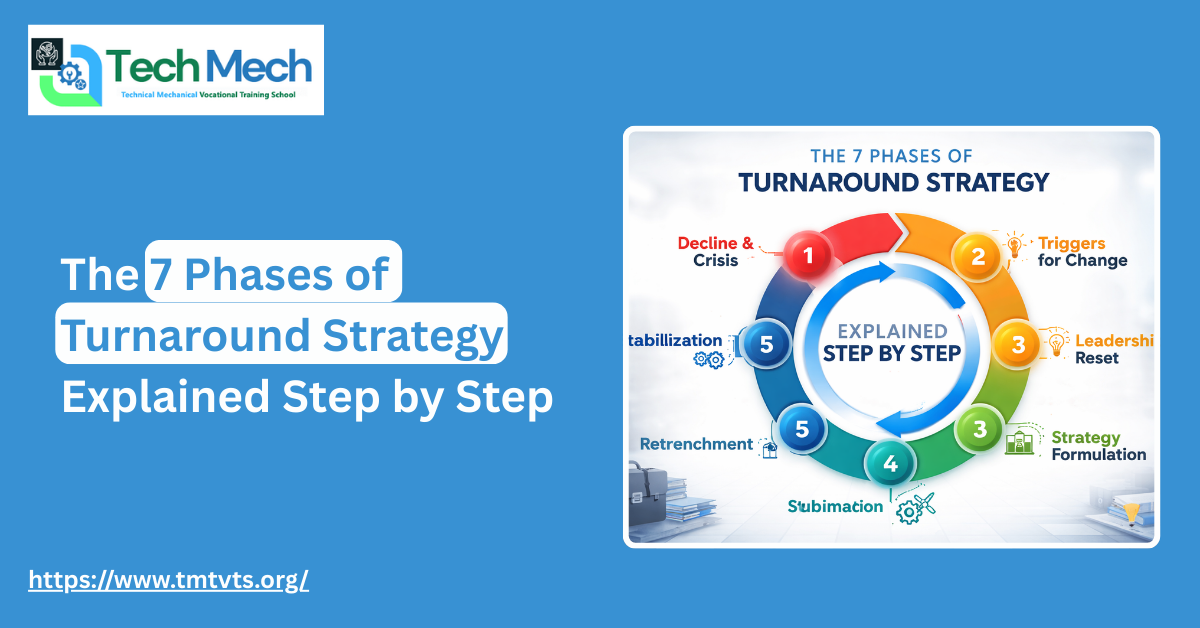
This article explains the 7 phases of turnaround strategy, from initial decline to long-term recovery and growth, in a clear and practical way.
What Is Turnaround?
Turnaround is a strategic process used to reverse a period of decline or poor performance and restore stability, performance, and growth. It involves identifying problems, taking corrective actions, and restructuring operations to stop losses. Turnaround focuses on improving efficiency, strengthening leadership, and rebuilding confidence among stakeholders. The ultimate goal of a turnaround is to move an organization from crisis to sustainable success.
What Is a Turnaround Strategy?
A turnaround strategy refers to a set of corrective actions taken by management to reverse a company’s poor performance. The goal is not only to survive a crisis but to rebuild the organization into a stronger, more competitive entity.
Turnaround strategies are commonly used in:
- Financially distressed companies
- Declining industries
- Organizations facing operational failure
- Businesses impacted by external shocks
Understanding the phases of turnaround strategy helps leaders act decisively and avoid costly delays.
The 7 Phases of Turnaround Strategy
Phase 1: Decline and Crisis Recognition
The first phase begins when a company enters decline. Warning signs may include:
- Falling revenues and profits
- Cash flow shortages
- Loss of market share
- Rising debt and operational inefficiencies
At this stage, denial is the biggest risk. Many organizations fail because leadership ignores early warning signals. Successful turnaround begins with recognizing the crisis honestly and early.
Key focus of this phase:
- Acknowledge performance decline
- Accept the need for immediate change
- Prepare the organization for tough decisions
Phase 2: Triggers for Change
Once the crisis is recognized, the next phase involves identifying the triggers for change. These triggers explain why the organization has failed.
Common triggers include:
- Weak leadership or governance
- Poor strategic decisions
- High operating costs
- Market disruption or technological change
- External economic or regulatory pressure
This phase is diagnostic in nature. Leaders must clearly understand the root causes of decline before designing any recovery plan.
Phase 3: Leadership and Strategic Reset
In many turnaround cases, a change in leadership is essential. New leadership brings objectivity, credibility, and urgency.
This phase often includes:
- Appointment of a turnaround CEO or management team
- Redefining roles and accountability
- Rebuilding stakeholder confidence
At the same time, leadership begins a strategic reset, questioning existing assumptions about markets, products, and operations.
Phase 4: Recovery Strategy Formulation
This is one of the most critical phases of turnaround strategy. Based on earlier analysis, management develops a clear recovery strategy.
The recovery strategy typically addresses:
- Core business focus
- Cost reduction opportunities
- Revenue improvement plans
- Asset utilization or divestment
- Market repositioning
A strong recovery strategy is realistic, data-driven, and time-bound. It focuses on what the company can do best, rather than trying to fix everything at once.
Phase 5: Retrenchment and Cost Restructuring
Retrenchment is often the most difficult but necessary phase. The objective is to stop financial bleeding and stabilize the organization.
Actions may include:
- Workforce reduction
- Closing unprofitable units
- Selling non-core assets
- Renegotiating debt and contracts
Although retrenchment can be painful, it provides the organization with breathing space to survive and reset. Without this phase, long-term recovery is rarely possible.
Phase 6: Stabilization and Operational Control
Once immediate losses are controlled, the focus shifts to stabilization. The company begins operating in a more predictable and disciplined manner.
Key priorities in this phase:
- Improving cash flow management
- Strengthening internal controls
- Enhancing operational efficiency
- Rebuilding customer and supplier trust
Stabilisation ensures that the organization does not slide back into crisis while preparing for future growth.
Phase 7: Return to Growth and Renewal
The final phase of turnaround strategy is return to growth. At this stage, the company is no longer in survival mode.
Growth initiatives may include:
- Launching new products or services
- Entering new markets
- Investing in technology and innovation
- Building long-term competitive advantage
This phase focuses on sustainability. The goal is not rapid expansion, but profitable and controlled growth supported by strong systems and leadership.
Why the 7-Phase Turnaround Framework Matters?
The 7 phases of turnaround strategy provide a structured roadmap for recovery. Skipping phases or acting out of sequence often leads to failure.
This framework helps:
- Business leaders make informed decisions
- Investors evaluate recovery potential
- Consultants design effective turnaround plans
- Students understand real-world business recovery
Common Mistakes in Turnaround Strategies
Despite having a framework, many turnarounds fail due to:
- Delayed decision-making
- Emotional attachment to failing strategies
- Inadequate cost control
- Poor communication with stakeholders
- Ignoring organizational culture
Understanding the phases helps avoid these mistakes.
How TMTVTS Can Help in Turnaround and Skill Development
At TMTVTS (Tech Mech Technical & Mechanical Vocational Training School), we understand that successful turnaround whether for individuals, organizations, or industries starts with skills, structure, and practical execution. Just as businesses require a clear turnaround strategy, individuals need targeted technical training to recover, reposition, and grow in today’s competitive job market.
Bridging the Skills Gap Through Practical Training
One of the main reasons individuals and organizations struggle is the gap between basic knowledge and real-world application. TMTVTS addresses this challenge through hands-on, practical-based training programs designed to meet modern industry requirements. Our approach focuses on:
- Practical skill development, not just theory
- Industry-aligned training standards
- Real-world problem-solving under workshop conditions
This practical model reflects the stabilisation and recovery phases of a turnaround strategy—where structure and discipline are restored.
Supporting Workforce Turnaround for Local and Overseas Markets
TMTVTS plays a critical role in workforce turnaround, particularly for candidates seeking employment in Saudi Arabia, Qatar, and other Gulf countries. We prepare trainees to meet:
- International safety standards
- Practical skill assessment requirements
- Employer-led testing environments
Our training ensures that candidates are not only experienced but job-ready, supporting long-term career recovery and growth.
Structured Learning for Sustainable Growth
Just as turnaround strategies focus on long-term renewal, TMTVTS emphasizes continuous learning and skill upgradation. Our courses help individuals move from:
- Basic technical knowledge → Professional competence
- Informal experience → Structured certification
- Local employability → Global readiness
This aligns with the return-to-growth phase of turnaround strategy, where sustainable success is built on strong foundations.
Industry-Relevant Certifications and Career Guidance
TMTVTS supports learners with:
- Skill-based certifications aligned with industry needs
- Practical evaluations similar to real employer tests
- Career guidance for local and overseas opportunities
By combining training with career direction, we help individuals avoid repeated cycles of decline and instead build stable, long-term professional growth.
Conclusion: Turning Skills into Opportunity
Turnaround is not only a business concept it is a career reality for many individuals. At TMTVTS, we help people restart, reposition, and rise through practical skills, structured training, and industry alignment.
Whether you are upgrading existing skills or starting fresh, TMTVTS provides the tools needed for real-world success and sustainable growth.
TMTVTS is a technical trade training center where students apply and develop job-ready skills.