

If you are a welder planning to work in Pakistan or the Gulf, you have probably heard these two terms many times: 6G welding and 6GR welding. Many job ads clearly mention “6G welder required” or “6GR certification mandatory.”
But what is the real difference between 6G and 6GR welding? Which one is harder? And which one gives better job opportunities and salary?
Is article mein hum simple aur practical language mein explain karain ge especially for students and job seekers taake aap sahi decision le sakain.
Understanding Welding Positions (Short Overview)
Before jumping into 6G and 6GR, it is important to understand what welding positions mean.
Welding positions describe:
- Pipe or plate angle
- Welder movement
- Difficulty level
For pipe welding, the common positions are:
- 1G – Pipe rotates, easiest
- 2G – Fixed pipe, horizontal weld
- 5G – Fixed pipe, no rotation
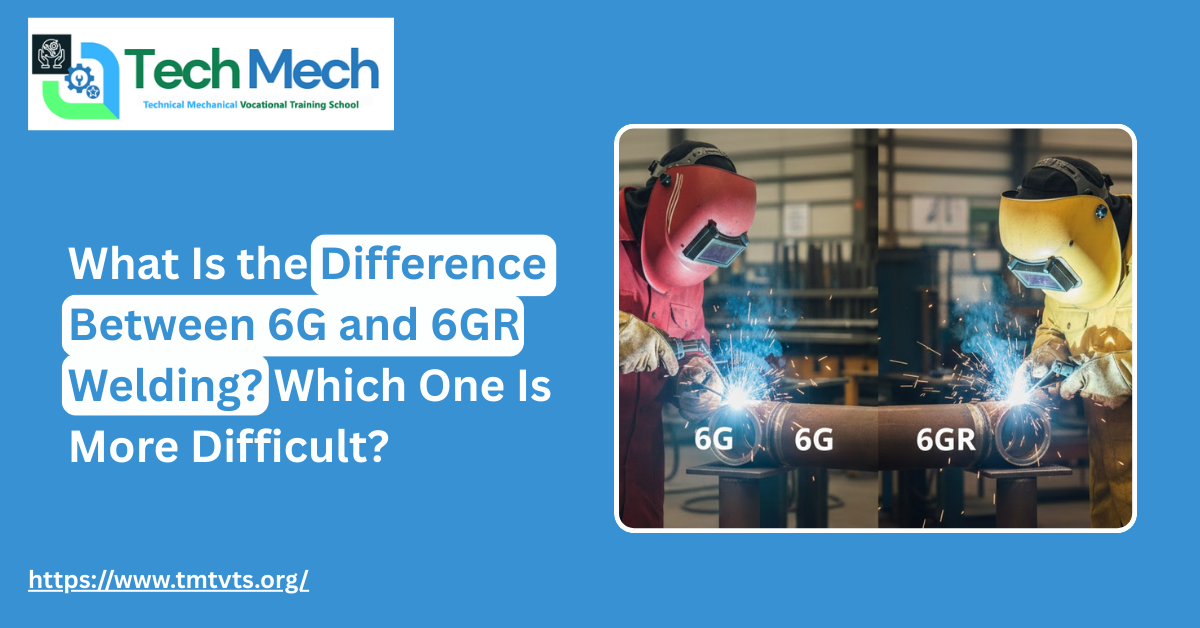
- 6G – Fixed pipe at 45° angle
- 6GR – Restricted 6G position
Among these, 6G and 6GR are considered the most advanced and difficult positions.
What Is 6G Welding?
Definition of 6G Welding
6G welding is a pipe welding position where:
- The pipe is fixed (does not rotate)
- The pipe is placed at a 45-degree angle
- Welding is performed all around the pipe
The welder must weld:
- Flat position
- Horizontal position
- Vertical position
- Overhead position
all in one single pipe.
Why 6G Welding Is Important
6G welding is widely used in:
- Oil & gas pipelines
- Refineries
- Power plants
- Pressure vessels
- Process piping
Because of its difficulty, 6G certification proves that a welder can handle almost all pipe welding situations.
Skills Required for 6G Welding
To pass 6G welding, a welder must know:
- Proper root gap and alignment
- Welding sequence
- Heat control
- Defect prevention (porosity, undercut, lack of fusion)
- Position control
Urdu Tip: 6G welding sirf haath ka nahi, dimagh ka bhi kaam hai.
What Is 6GR Welding?
Definition of 6GR Welding
6GR welding is an advanced version of 6G welding with additional restrictions.
In 6GR:
- The pipe is fixed at a 45-degree angle
- A restricting ring or plate is attached near the joint
- The restriction blocks normal torch or electrode movement
This simulates real offshore and structural conditions where access is limited.
Where Is 6GR Welding Used?
6GR welding is mainly required in:
- Offshore oil & gas platforms
- Structural pipe connections
- Jacket structures
- High-risk industrial installations
This position tests:
- Skill under pressure
- Welding accuracy in tight spaces
Why Employers Ask for 6GR Certification
6GR certification shows that a welder can:
- Work in restricted areas
- Maintain weld quality under difficulty
- Follow strict international standards
That is why 6GR welders are highly valued in Gulf countries.
Key Differences Between 6G and 6GR Welding
| Feature | 6G Welding | 6GR Welding |
|---|---|---|
| Pipe position | Fixed at 45° | Fixed at 45° |
| Pipe rotation | No | No |
| Access | Normal access | Restricted access |
| Difficulty level | Very high | Extremely high |
| Used in | Pipelines, refineries | Offshore & structural |
| Certification demand | High | Very high |
| Salary potential | High | Higher |
Which Welding Position Is More Difficult?
6G vs 6GR: Difficulty Comparison
6G welding is already difficult, but 6GR is more challenging due to restricted movement.
Why 6GR Is More Difficult
- Limited electrode or torch angle
- Less visibility
- Harder body positioning
- Greater chance of defects
- Requires perfect control
Industry Fact: Many welders pass 6G but fail 6GR on the first attempt.
Types of Welding Used in 6G and 6GR
Both positions can involve different welding processes:
SMAW (Stick Welding)
- Most common for pipe welding tests
- Requires strong hand control
GTAW (TIG Welding)
- Used for root pass
- High precision required
Combination Welding
- TIG root + SMAW or FCAW fill and cap
- Common in Gulf projects
Which Certification Is Better for Jobs?
For Pakistan Jobs
- 6G welding is usually sufficient
- Required in refineries, power plants, and construction
For Gulf Jobs
- 6G is good
- 6GR gives extra advantage, especially for:
Simple rule: Agar Gulf ka plan hai aur offshore ka experience chahiye, 6GR best hai.
Salary Difference Between 6G and 6GR Welders
While salaries depend on company and country:
- 6G Welders: Good salary, stable demand
- 6GR Welders: Higher salary, fewer skilled workers
Employers pay more because 6GR skills are rare.
Common Mistakes Welders Make in 6G / 6GR Tests
- Poor root penetration
- Inconsistent bead profile
- Wrong electrode angle
- Heat imbalance
- Panic due to pressure
Proper training and practice solve these issues.
How to Prepare for 6G and 6GR Welding Tests
Training Tips
- Practice all positions daily
- Focus on root pass quality
- Learn defect identification
- Improve body posture
- Train under real test conditions
Choosing Pakistan’s best training institutes center plays a major role here.
Role of Training Institutes
Not all institutes teach real 6G or 6GR skills.
A good institute offers:
- Practical workshops
- Real test simulations
- Experienced instructors
- Trade testing and verification
Institutes offering Welding courses in Pakistan must align training with Gulf standards.
Frequently Asked Questions (FAQs)
Q1: Can a beginner learn 6G welding directly?
It is recommended to start from basic positions before moving to 6G.
Q2: Is 6GR certification mandatory for Gulf jobs?
Not mandatory everywhere, but highly preferred for offshore and structural work.
Q3: Which is harder, 6G or 6GR?
6GR is more difficult due to restricted access.
Q4: Can SMAW be used for 6GR welding?
Yes, SMAW is commonly used in 6GR tests.
Q5: Where can I learn 6G and 6GR welding in Pakistan?
Recognized vocational institutes with real workshops and trade testing facilities.
Train for 6G & 6GR Welding with Tech Mech
Tech Mech Technical Vocational Training School provides professional training in:
- 6G pipe welding
- 6GR restricted welding
- SMAW, GTAW, FCAW
- Pipe fitter and structural welding
We prepare welders for Pakistan and Gulf job requirements with proper skill testing and trade verification.
Contact Tech Mech today and move your welding career to the next level.
Final Summary
Understanding the difference between 6G and 6GR welding is critical for career growth. While 6G welding proves advanced skill, 6GR demonstrates mastery under extreme conditions. For welders aiming at high-paying Pakistan and Gulf jobs, investing in the right training and certification makes all the difference.
Choosing the right school and learning real, practical skills not just theory will define your success in the welding industry.