
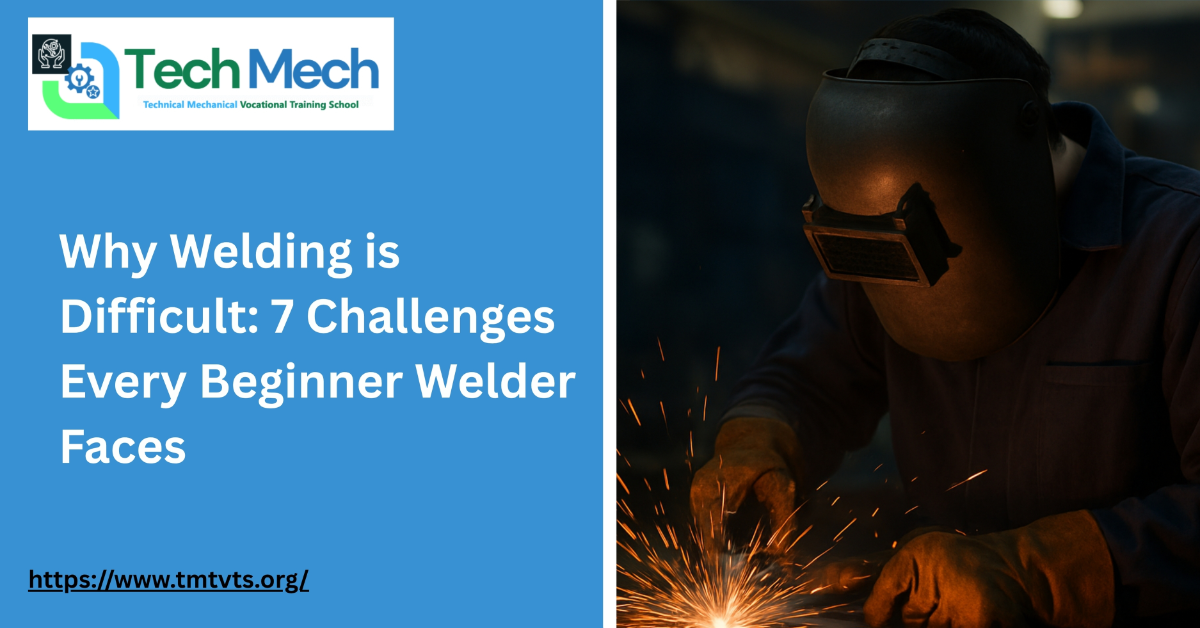

Welding is one of the most respected technical skills in the world and for good reason. From construction and fabrication to oil & gas, shipbuilding, and heavy industries, welders literally keep the world together. But anyone new to the field quickly discovers one truth:
Welding is not easy.
It takes training, practice, discipline, and the right guidance. Many beginners struggle at first, and even experienced welders sometimes face challenges due to advanced materials, safety risks, or tight-quality requirements. Whether you’re a business owner, a new welder, or a decision-maker hiring welders in Pakistan or the Gulf region, understanding why welding is difficult helps you choose better training, improve safety, and get higher-quality results.
In this post, we’ll break down 7 common challenges every beginner welder faces, with practical advice and real examples from industry environments.
1. Maintaining a Steady Hand and Proper Technique
Welding requires precision every small movement affects the strength, appearance, and safety of the weld. Many beginners struggle with:
- Shaking hands
- Moving the torch too fast or too slow
- Incorrect angles
- Inconsistent travel speed
For example, in MIG welding, even a slight tilt of the gun can cause poor penetration or too much spatter. In TIG welding, the challenge is even bigger because you must use both hands: one for the torch and one for feeding the filler rod.
Why it matters
A shaky hand creates weak welds, which can fail under pressure a major risk in industries like pipelines, oil refineries, and heavy machinery.
How to overcome it
- Practice correct posture
- Rest your elbows or arms whenever possible
- Choose easier processes first, such as MIG before TIG
- Take structured welding courses for hands-on guidance
A professional training environment teaches muscle memory, which is something no YouTube video can replace.
2. Understanding Heat Control and Metal Behavior
Controlling heat is one of the biggest difficulties in welding. Beginners often:
- Overheat the metal
- Burn through thin sheets
- Fail to reach proper temperature
- Cause warping or distortion
Different metals react differently. Stainless steel heats faster. Aluminum cools rapidly. Carbon steel requires deeper penetration. Without training, a beginner cannot guess these variations.
Practical example
A welder working on a pipe joint in a refinery must ensure proper penetration; otherwise, a weak joint can cause leaks or system failure. Heat control plays a crucial role here.
How training helps
A good welding certificate program teaches metal behavior, amperage settings, and how to read weld puddles accurately.
3. Safety Risks and Proper PPE Use
Welding is physically demanding and can be dangerous without the right precautions. Beginners often underestimate:
- UV radiation
- High temperatures
- Sparks and flying slag
- Fume inhalation
- Electric shock risk
Even improper helmet settings can cause “arc eye,” a painful condition similar to a sunburn on the cornea.
Common beginner mistakes
- Wearing low-quality gloves
- Skipping protective boots
- Using cheap or incorrect helmets
- Not understanding ventilation requirements
Industry insight
Gulf-based welding jobs typically follow strict safety standards (ISO, OSHA). Poor safety habits lead to immediate rejection during welding tests.
4. Knowing Which Welding Process to Use
There is no single “best” welding method it depends on the job. Beginners often feel confused between:
- MIG welding (easier for new learners)
- TIG welding (cleaner but more difficult)
- Stick welding (SMAW) (good for outdoor or heavy work)
- Flux-core welding (strong penetration, common in construction)
Choosing the wrong method can produce low-quality welds and add project delays.
Example from real industry
A fabricator in the Gulf may prefer TIG for stainless steel kitchen equipment, but stick welding for outdoor pipeline repairs. A beginner trained in only one method will struggle to meet job demands.
5. Difficulty Reading Welding Symbols and Blueprints
Welders do more than join metal they must understand:
- Technical drawings
- Symbols
- Joint types
- Material specifications
- Welding sequence
These skills are often more challenging than the welding itself.
Why beginners struggle
Blueprint reading is not naturally intuitive. Many people entering welding prefer hands-on work, but the industry requires technical literacy too.
How training helps
The best welding schools in Pakistan and the Gulf emphasize blueprint reading in combination with practical training, preparing students for international job tests.
6. Producing Consistent, High-Quality Welds
Anyone can make a weld but not everyone can make a consistent weld.
Beginners struggle to repeat the same quality across:
- Multiple joints
- Different positions (flat, vertical, overhead, horizontal)
- Various thicknesses
- Changing environmental conditions
For example, welding overhead requires excellent control to prevent molten metal from dripping. Many new welders find it intimidating at first.
Industry takeaway
Gulf employers often test candidates in several positions. Without consistent practice, passing these tests becomes difficult.
7. Lack of Proper Training or Real-World Practice
Many beginners think welding is just about joining metal, but real learning happens through:
- Hours of supervised practice
- Correcting mistakes
- Learning advanced techniques
- Understanding materials
- Preparing for job tests
Self-taught welders often develop bad habits. That’s why companies and recruitment agencies prefer candidates who have completed structured training from a reputed institute such as the best welding school in Pakistan or accredited Gulf-region centers.
Why formal training matters
A good welding certificate program provides:
- Hands-on practice
- Experienced instructors
- Safety awareness
- Industry-required testing
- Skill assessments
- Job placement assistance
This dramatically increases chances of securing high-paying welding jobs in Saudi Arabia, UAE, Qatar, and Oman.
How to Overcome These Challenges: Practical Tips
Here are actionable steps both beginners and employers can follow:
For New Welders
- Enroll in a certified welding course
- Practice regularly with small projects
- Experiment with different positions
- Use proper safety gear
- Start with MIG, then progress to stick and TIG
- Learn metal identification and settings
For Business Owners & Recruiters
- Hire welders trained through recognized welding certificate programs
- Invest in technical skill assessments
- Provide refresher training to maintain welding quality
- Offer modern equipment and PPE
Skilled welders reduce downtime, rework, and safety issues.
FAQs – People Also Ask
1. Why is welding so difficult to learn for beginners?
Because it requires hand–eye coordination, heat control, and strong understanding of metal behavior skills that only develop with practice and proper training.
2. How long does it take to learn welding professionally?
Basic welding skills can be learned in a few months, but mastering multiple processes (MIG, TIG, Stick) typically requires 6–12 months of structured training.
3. Do welding certificates matter for Gulf jobs?
Yes. Gulf employers routinely require certified welders and often test them before hiring. A recognized welding certificate increases job success significantly.
4. What is the easiest welding method for beginners?
MIG welding is generally the easiest to learn due to its smooth arc and simple gun operation.
5. Which is the best welding school in Pakistan?
Schools offering practical training, international testing, and job placement like Tech Mech Technical Vocational are preferred by both local and Gulf employers.
Ready to start your welding career or hire certified welders?
Tech Mech Technical Vocational Training School offers welding courses, welding certificates, and skilled workers for welding jobs, pipe fitting, grinder work, and recruitment solutions in Pakistan and the Gulf. Contact us today to get started.
Conclusion
Welding may be challenging, but with the right training, guidance, and practice, anyone can master it. The key is choosing a training school that builds both your confidence and your technical skills. Whether you’re looking to start a welding career or hire skilled welders, investing in proper training makes all the difference.
Tech Mech Technical Vocational Training School continues to support welders, companies, and Gulf employers with high-quality training and skilled manpower solutions. Choosing the right school not only improves skill but also opens a pathway to better job opportunities and long-term success.